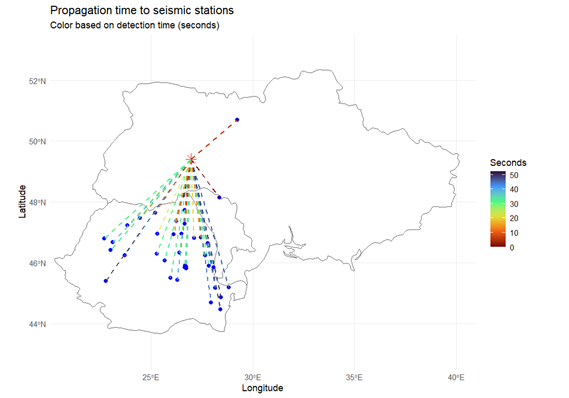
On May 13, 2023, a large explosion occurred in the Khmelnytskyi Oblast, western Ukraine. The blast originated from a military ammunition storage site, reportedly struck by Russian missiles. This event generated significant acoustic and seismic signatures, detectable across regional monitoring networks, and produced an atmospheric dispersion of particulate matter.
Seismic monitoring networks in Romania detected a short-duration, high-amplitude ground motion pulse indicative of a near-surface explosion rather than tectonic activity. The event’s epicentral coordinates were estimated at approximately 49.4°N and 26.8°E, corresponding to the Khmelnytskyi region, where a military ammunition storage facility was located.
Quantitative analysis of waveform amplitudes and frequency spectra suggests an equivalent local magnitude of ML ≈ 3.4 ± 0.2, consistent with the detonation of a substantial volume of stored explosives. The estimated energy release corresponds to approximately 10–15 tons of TNT, placing this explosion among the most energetic non-nuclear events recorded in Europe during 2023. The distinct seismic characteristics of the signal provide clear evidence of an anthropogenic source.
Numerical modeling of atmospheric particle transport was performed, using HYSPLIT model, to estimate the potential trajectory and spatial extent of the plume generated by the Khmelnytskyi explosion. The simulation results indicate that, within the first 84 hours following the detonation, the modeled aerosol plume was advected northeastward under prevailing synoptic wind conditions. The estimated injection altitude for the particulate matter was up to 2 km above ground level. The simulated transport pathway extended from Khmelnytskyi to western Belarus.